A fixed thermal camera covers a defined field of view. Everything outside it is unobserved, so full coverage means many units, many mounts and much cabling. On a site with a wide open approach and few places to mount anything, that quickly becomes unaffordable.
The problem
Fixed cameras look where you pointed them.
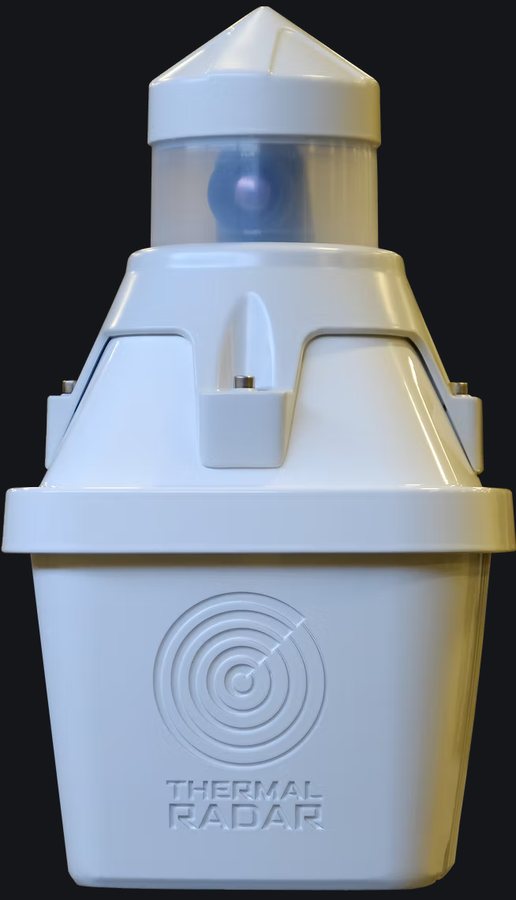
Full circle from one mount
A rotating thermal sensor steps through configurable station stops to build a panoramic view. Depending on sensor, lens, mounting height and terrain, one unit can monitor up to roughly 220 acres, with detection reaching about 500 metres in suitable conditions.
Detection with position
Onboard analytics geospatially locate each detection and place it on a map, so the alert says where — and can slew a PTZ camera onto it for visual confirmation while the sensor keeps scanning everything else.
Where mounting points are scarce
Particularly suited to sites with a single high point — a headgear, a silo, a tower or a lodge roof. Solar-powered tower and trailer configurations are available where there is no mounting structure and no power at all.
Thermal Radar and Hikvision
We deploy and integrate both, chosen on detection range, resolution and control-room integration. Optional early fire detection can run on the same unit as intrusion monitoring — relevant on farms, forestry and mine sites where veld fire is as real a threat as intrusion.
Why a rotating sensor changes the maths.

Where it fits
Thermal radar or ground radar?
They solve overlapping problems differently. Ground radar excels at tracking targets across large open ground with precise positioning. Thermal radar gives continuous visual thermal coverage in every direction from one point. On larger sites we often deploy both, and on smaller ones we tell you honestly which single option is enough.
Book a free site assessment.
Tell us about your site and we will come back within one business day. No obligation, no pressure.